In a workshop I attended last week, we talked about modeling consciousness as a behavior that emerges from small, interacting components. When combined a certain way, these components can be more intelligent than their individual parts. Humans, for example, comprise non-mindless, non-autonomous cells that collaborate and compete to generate “consciousness” and subsequently “intelligence” and “creativity”. Now, in the age of generative AI, we question whether AI is truly intelligent and creative, and the implications of human-AI collaboration on intelligence and creativity. In this blog post, I’d like to focus on how I think about the creative aspects of human-AI collaboration.
The increasing use of AI in creative work has caused moral panic. Some argue that this panic can be delineated into two separate issues: artists’ livelihoods are threatened by AI development, and there is a change in artistic culture. Many would agree that the former is a real concern, but some may disagree on how we should think about the latter. Art has always been tied to the technologies of a society. When photography was invented in the 19th century, society panicked because cameras could capture things that humans couldn’t paint, and mimetic painting seemed to become redundant. However, painters responded by creating new abstract forms of painting like cubism and dadaism. Might we see a similar response now? Should we be focusing on the new forms of art that emerge from the rise of AI instead of on the ways it might diminish the creative experience and devalue existing creative work?
I think that in addition to the threat for artists’ livelihoods, the change in artistic culture is something to be concerned about. In my own experience and the experience of many of my peers, there are certain kinds of AI-human collaboration that feel wrong or perverse. So, I wanted to disentangle the forms and characteristics of AI-human collaboration in art and how I think about them. I’m not necessarily aiming to convince, more so writing to think. First, I’d like to discuss aspects of AI art that worry me. These are concerns I have to varying degrees depending on how deeply an artist uses AI in the creative process. In the worst-case scenario, the user is a “prompt artist” that engages back and forth with an AI to create art that the user likes. In the best-case scenario, AI is used in a unique or localized way that isn’t simply just offloading the creative process. In the second section, I look at a couple ways that AI has been used in art, that I find inspiring and acceptable rather than concerning. Because I’m primarily a musician, expect music to be overrepresented in my examples.
Concerns of AI Art
Lack of Informed Consent
One of the biggest and earliest critiques of AI art is that it was trained on human artists’ data, and these artists did not give consent for their art to be used to train AI systems. Despite this, artists have a more favorable view about other humans (as opposed to machines) using their work as inspiration for their art. What’s different about these two cases? One aspect could be related to the differences between a human artist’s and an AI’s creative process, which I’ll discuss more in the “lack of emotional resonance” section below. Here, I’d like to focus on ownership.
In our current legal system, an original artist owns their work, and imitation or derivation above a certain level must include citation or compensation. In the case of generative AI, the work is necessarily derivative and imitative. Of course, the line between imitation and inspiration is blurry, but there is more plausible deniability for a human than an AI to have been inspired but not intended to imitate. There are a lot more confounding factors in the human case. You could argue that AI is just a tool and should not be subject to the same limitations as humans when it comes to using other people’s work. But at the end of the day, humans are still the ones building these tools and using their output.
One critique of this argument is that it is based on a Eurocentric, neoliberal, individualist notion of creativity, that artworks are owned exclusively by the artist who produces them. I don’t disagree that we could think of art as belonging to the collective, but our current systems don’t treat art and intellectual property as collective property. Arguing that we should have collective ownership over art with the intent of using it for AI necessitates upending our current paradigm of intellectual property. Even if we accept this notion of collective creativity, that the art created by artists and AI belong to all, is it not the case that the artwork and the process to generate it are treated as a product to gain profits and sales from? I am skeptical of the motivations of collective agency frameworks when it relates to AI and to what end it will benefit collective human creativity rather than further diminishing art as commodity. I take issue with the fact that we’re advocating for collective ownership of artwork but not collective ownership for other things that were historically considered collective property, most notably, land.
Lack of Emotional Resonance
Perhaps artists are opposed to the fact that their art is mechanistically inferred upon rather than engaged with by a human. Maybe it’s the lack of a human connection in the creative process. One interpretation of being “inspired” by a piece of art is resonating with it on an emotional level, and this resonance is influenced by a person’s history, lived experiences, cultural heritage, and values. AI, however, doesn’t have any of its own personal history or lived experiences or values. It simply mimics these things by drawing on other people’s lives, and in the case of values, its creators’ preferences. It feels like a necessary step in “being inspired” is absent.
There’s not a unique perspective from which AI sees the world that narrows down the sphere of inspiration. It’s inspired by everything equally, and in most cases, it requires the human to guide it through what to create. Still, even if AI was guided through generating art based on the human’s inspiration, the human didn’t make the art themselves. This scenario is analogous to the following example: author Brandon Sanderson has worked with visual artist Ben McSweeney to create sketches based on Sanderson’s Stormlight Archive books. Creating these sketches required back and forth with the artist, much like the conversational dynamic of a user with an AI tool. However, the artwork is credited to the McSweeney, the person who created the artwork, rather than Sanderson, who directed its creation.
What about decades into the future? Will AI have “lived” then? I think this depends on how deeply integrated into human society AI will be, and whether we can narrow down the learning/training process and experience of an AI so that each agent has a unique “life”.
Reducing Art to Commodity and Promoting Consumerism
Many people use generative AI to generate a work of art from start to finish very quickly with the intention of consuming but not deeply engaging with the art. One could even question if the art can be deeply engaged with in the first place. We’ve seen this issue before: whenever Disney produces unnecessary live action remakes instead of new, original movies; whenever the Marvel Cinematic Universe releases a new movie in the franchise with a barely modified recipe of flashy action scenes and upbeat 80s music; whenever Netflix recycles popular plots and characters and settings to make new content. These are examples of large corporations producing art as commodity, to generate the greatest demand, to be consumed then forgotten. Now, I don’t think there’s anything inherently wrong with entertainment—not all movies need to be intellectual and thought provoking—but creating repetitive, commodified art results in diminishing returns to the value of the artwork to society and diminishes our relationship with art. There has always been a tension between economic incentives and artistic pursuit, and AI development has exacerbated that.
Creative Homogeneity
Technology has always made art more accessible. The invention of the radio enabled musicians to reach a wider audience and listeners to discover new music from wherever they could get a broadcast. After the 1996 Telecommunications Act, radio channel ownership was consolidated in the hands of a few major corporations whose strategy was to play music they saw as “safe” and “popular”, relying on playlists based on market research rather than music the DJs found interesting (if there was a human DJ on air at the time). Then came streaming. Algorithms that prioritized listener playthrough suggest songs that are similar to songs the user has liked before. This has resulted in a musical echo chamber of sorts and reduced the breadth of discovery. (I’m still not sure why YouTube more often recommends me interesting music that I’d never heard of before and end up liking, as opposed to Spotify, where recommendations are clustered towards similar bands and artists.)
Whereas previously we were concerned with our exposure to a less diverse set of music, we are now faced with the possibility of producing less diverse music. I can see a future in which purely AI generated music dominates the airwaves, and all music will sound the same. If AI is trained on the same music, and a certain sound is disproportionately represented, AI will compose based on this nonrepresentative sound, resulting in more of that sound, causing AI to compose more of it, and so on. One could argue that this is already the case with pop music. I don’t disagree. Compositionally pop music is very formulaic. Big labels optimize for popularity and profit. However, I’m not sure the music itself is the point of pop music and pop artists. It’s their brand, their message, their community of fans. In this regard, they are differentiated.
Could this homogenization result in a slowdown of creative progress? Scholars have argued before that the use of AI could be slowing down scientific progress. One reason is that hypotheses are generated from the same training data, so nothing new or groundbreaking will be generated by AI. As a result, we might have a greater quantity of journal articles published, but they don’t add that much to human knowledge. While it could be the case that as science progresses, new ideas become harder to find, historically, we have had breakthroughs right after a period of stagnation and saturation. In other words, we have always been proven wrong. We could argue that a similar process could happen the arts and in the creative industry, where we don’t have any novel ideas for new artwork, and all new art is just a little different from any existing art.
Lack of Human Connection
A huge joy of making art is the artistic community you engage with. When making music, you might jam with, write with, play shows with, learn from, and be inspired by other musicians. In that process, you form emotional bonds with each other. Maybe you have fond memories of learning piano with your mother. Maybe you were a misunderstood teenager who found solace in post-hardcore bands and their online fanbase. Maybe you moved to a new city and wasn't sure how to make friends, but then you jammed with some people and got drinks afterwards and find out they’re lovely people that you’d like to get to know better. Maybe your band is writing a song and you’re having a heart-to-heart and one person’s riff inspires another person’s melody which inspires a type of rhythm which inspires some lyrical idea. And maybe you play that song at a show and someone comes up to you and tells you they were so moved by what you've written. You can’t really build this kind of connection and community with AI. At the very least, they won't be as meaningful.
Diminished Enjoyment
I’m a strong believer that using too much AI to create art takes the joy out of it precisely because you’re not doing any of it. One of the most fulfilling moments in creating art is when you’ve spent all this time thinking and brainstorming and noodling, and then you finally found the right elements, the right composition, the right techniques and structure and textures to express what you’ve been wanting to express! The active process of synthesis towards what you want to express makes the final product feel like an accomplishment, a true expression of yourself. Are you really going to let AI take that away from you?
Acceptable AI Art
Based on my concerns above, I think that acceptable AI art has the following characteristics.
- Doesn't use other artists' work without appropriate consent,
- Is motivated by creativity rather than production,
- Attempts to do new things that AI is uniquely equipped to do, and
- Fosters human connection.
Some examples of acceptable AI art are
- As an artistic medium or using a specific AI tool instead of pure generation,
- To recreate lost information, or
- Trained on a single artist’s own work by that artist.
What’s unacceptable to me is using AI to generate art from start to finish, essentially making it do the job for you.
Here are two examples of what I think are acceptable AI-related artistic projects.
Conversions – Agnieszka Kurant
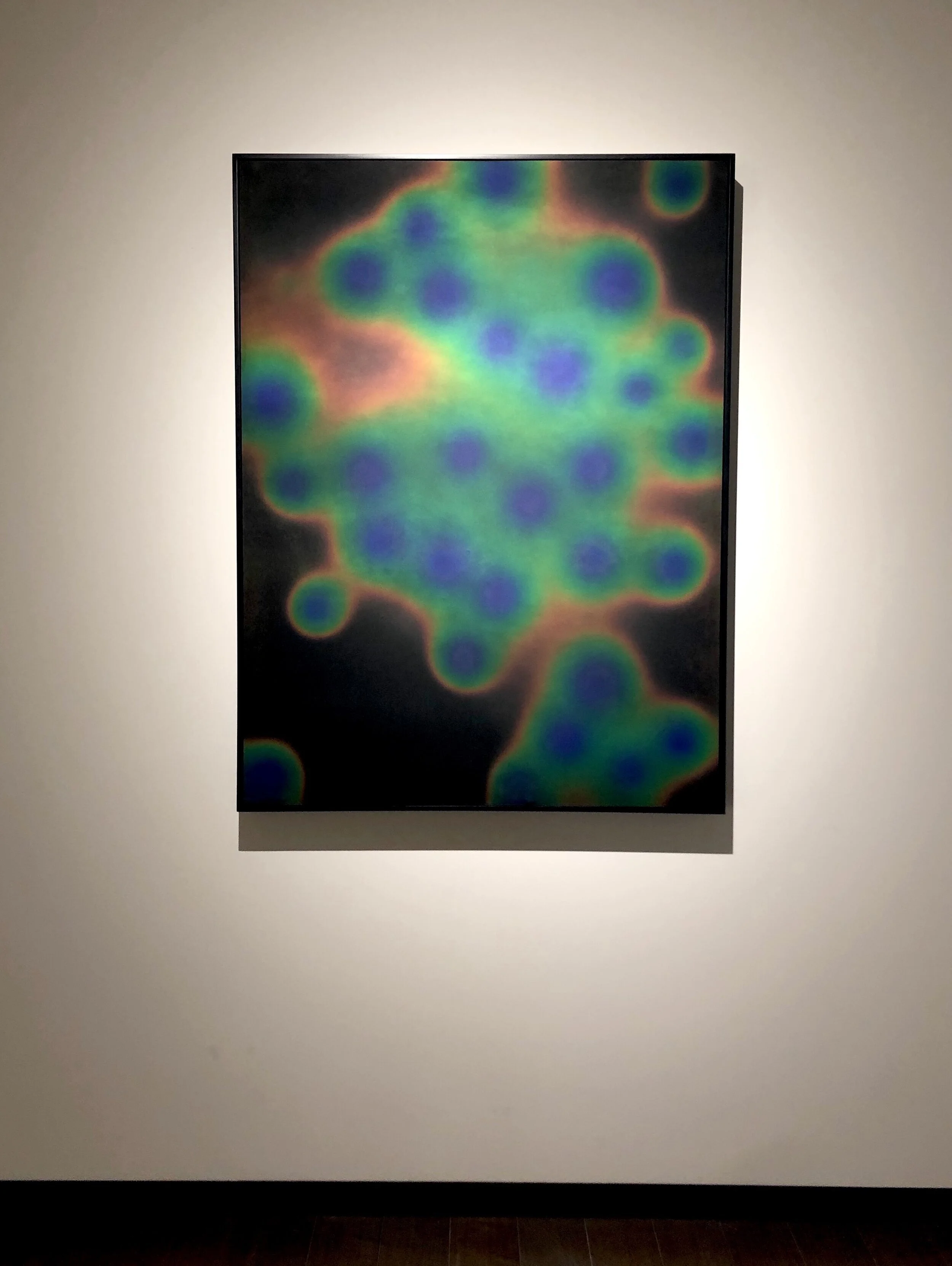
The artwork is a constantly shifting gradient of colors that is described as “displaying the effects of collective intelligence in contemporary algorithmic and technological society”.
Here’s how it works: First, extract tweets of activist organizations from around the world and conduct sentiment analyses. Then, run an agent-based model of a sugarscape simulation. In the simulation, agents are bugs on a two-dimensional grid that contains sugar and spice. They can consume and trade both sugar and spice. The sentiment of the protesters is used to determine regrowth of sugar in the sugarscape. You can find the code here.
This project utilizes the unique abilities of computers like scraping, sentiment analysis of a large dataset, and perpetual simulation. Overall, the flow of data is determined by the artist, even though the result of the simulation is not. Furthermore, it prompts conversation and awareness about all the protest movements happening around the world. In other words, there is craft involving specific AI tools, and the final artwork is something to be engaged with.
Once Upon a Garden – Linda Dounia
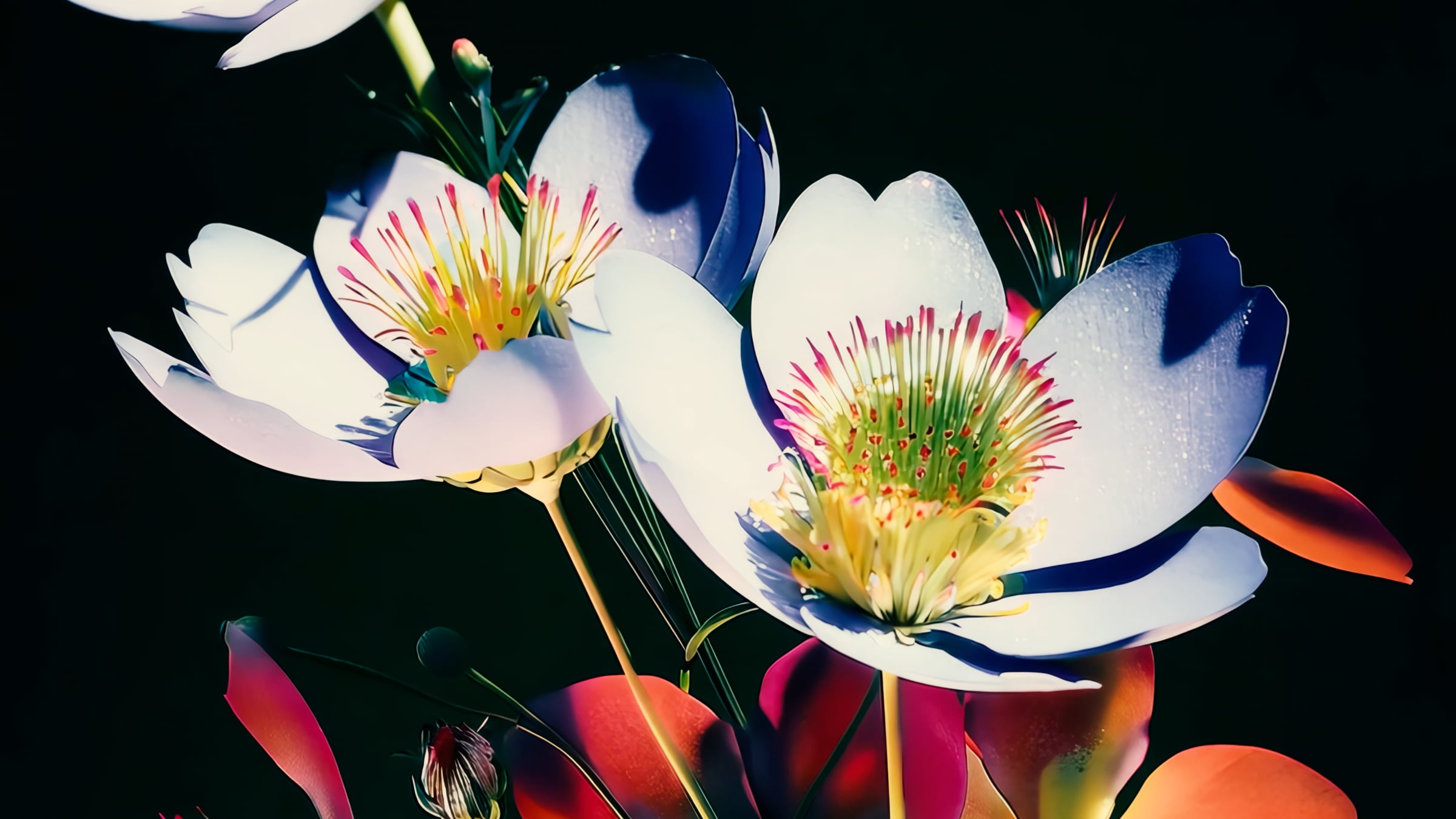
In this project, Dounia attempts to reconstruct extinct and endangered flora of Sahel, West Africa. First, they train a Generative Adversarial Network (GAN) on images of these plant species. They also include synthetic images generated from textual descriptions of these plants. Then, they do a couple iterations of running text-to-image diffusion models (combination of a language model with a generative image model) on the outputs. From there, the artist creates more chaotic arrangements and reduces the quality of the images by adding non-organic materials and feeding the images through an Image-to-Image pipeline. The result is a futuristic synthesis of what these plants could look like.
What primarily draws me to this project is its aim to recover missing biodiversity and how the artist chose the specific steps in order to recreate that biodiversity. Furthermore, it sheds light on how technology has been focused on Western contexts and expanding Western knowledge. The artist also has a great framework for what they think is fair AI use, including gathering their own data for training because it doesn’t exist or is outdated or lost.
Final Thoughts
It is an interesting time in the world right now where AI is creeping into every single part of our lives. We've all heard about the impact of AI on critical thinking skills and emotional regulation. What about on creativity? This blog post has thus far served as a "thinking out loud" tool for me to engage with my thoughts about why AI art worries me. AI derives work from existing artists without appropriate consent and AI doesn't have the ability to resonate with or be inspired by art as humans do. Moreover, the overproduction of AI art reduces art to a commodity and potentially leads us into creative homogeneity. Overusing AI in art also strips away the joy and connection we feel from making art. Despite this, I think there are really cool use cases of AI in art that are creative and respectful. Overall, we need to be very intentional about how we use AI for creative work and how our habits impact our collective lives in the long term.